


Listen now on your favorite streaming platforms!
Physical CDs are also available!
Interested in a physical CD? Let us know below!
We originally set out to record what would have been called “A Collection of Short Stories” – evocative, bite-sized musical tales that together create a sonic narrative. Over the course of production, we found ourselves drawn to “Mystic Journey”, taken from the title of Kevin Lau’s sonata for violin and piano presented on this album. This title applies so beautifully to the project as a whole and perfectly fits our vision for this collection of music.
Embark on the journey in the order we’ve curated, or create your own. There’s no wrong way to listen.
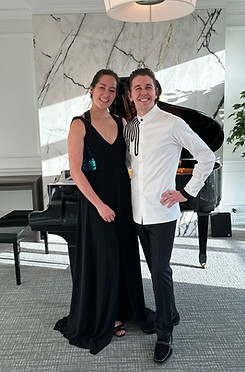
From Ezra
Program Notes by Ezra
Habanera
Claude Champagne
A French-Canadian composer, teacher, pianist, and violinist, Claude Champagne composed his Habanera for violin and piano in 1929. Born in Montréal in 1891, he began studying piano and theory at age 10 and took up what became his favorite instrument, the violin, at age 14. Champagne was generously sponsored by composer and pianist, Alfred La Liberté, to study in Paris from 1921-1928. Habanera was written following his return to Montréal in 1928, where he split his time between teaching, administration, and composition due to the increased musical needs of the community.
We were introduced to this piece through Jacob’s doctoral advisor, Robin Elliott, the editor for the Chamber Music III: Duos volume of the Canadian Musical Heritage Society collection in which Champagne’s Habanera appears.
La Nuit
Félicien-César David (arr. Henri Vieuxtemps)
A French Romantic composer and contemporary of Hector Berlioz, Félicien David composed his ode-symphonie en trois parties (Ode-Symphony in three parts) for speaker, tenor, male chorus and orchestra entitled Le Désert in 1844 – I. L’entrée au désert (Entering the Desert), II. La nuit (Night), III. Le lever de soleil (Sunrise). The libretto was written by publicist, lawyer, and editor, Auguste Colin – David and Colin likely met while travelling to Turkey and Egypt in 1833-35 as part of a group of Saint-Simonian missionaries, where David was the official group composer and Colin the official group poet.
Taken from the second part bearing the same title, La nuit was arranged for viola and piano by Belgian composer, violinist, and violist, Henri Vieuxtemps. We pulled this piece from the depths of Jacob’s mental repertoire encyclopedia, where it lives among other pieces by Vieuxtemps such as the Élégie, Op. 30 and Sonata for Viola and Piano in B-flat Major, Op. 36.
Hymne a la nuit from the libretto by Auguste Colin (original libretto published 1845)
English translation by John Troutbeck
Ô nuit, ô belle nuit,
Ta fraîcheur nous réjouit,
Quand après la prière,
Sur le sable mouvant,
La caravane entière
Se repose en rèvant.
Ô nuit, ô belle nuit,
Ta fraîcheur nous réjouit,
Comme une amante
Comble l’attente d’amour,
Tu calmes l’ardeur dévorante du jour.
Ô nuit, ô douce nuit!
Ô nuit, ô belle nuit,
Ta fraîcheur nous réjouit,
Quand l’air rempli d’arôme,
Aux sons du tarabouk,
L’almée ondule, comme
La vapeur du chybouk.
Ô nuit, ô belle nuit,
Ta fraîcheur nous réjouit,
Comme une amante
Comble l’attente d’amour,
Tu calmes l’ardeur dévorante du jour.
Ô nuit, ô douce nuit!
O night, O lovely night,
Thou dost bring us pure delight,
When in prayer we have bent us,
And on the tranquil plain,
All they that long have wander’d,
In repose now remain.
O night, O lovely night,
Thou dost bring us pure delight,
As when a lov’d one
A faithful heart will repay:
By thee is calm’d the wasting ardour of day
O night, O gentle night!
O night, O lovely night,
Thou dost bring us pure delight,
When the air is full of fragrance,
When, led by music sweet,
Girls, in the dance combining,
Nimbly ply twinkling feet
O night, O lovely night,
Thou dost bring us pure delight.
As when a lov’d one,
A faithful heart will repay:
By thee is calm’d the wasting ardour of day,
O night, O gentle night!
Elegy for Viola and Piano
Patricia Morehead
A favorite work of ours by Canadian composer and oboist Patricia Morehead, the Elegy for viola and piano is an emotionally gripping work for both listeners and performers. We first performed the Elegy in Toronto’s Koerner Hall in 2020 in a concert celebrating Morehead’s 80th birthday, and this was the first piece we chose when selecting repertoire for the album.
Program note by Patricia Morehead:
Elegy for viola and piano is an outpouring of emotion concerning a close relative who has an incurable mental disorder. Through the composition of the piece I was able to express my anguish for this individual. The piece is constructed over a five note cantus firmus which serves to unify the work. The music was originally composed for English horn and piano and was transcribed for viola and piano by the composer.

We are so grateful that Pat was able to join us at our album release party in 2024 as well!
Annabel Lee
Bruno Degazio
Based on the famous Edgar Allan Poe poem Annabel Lee, this piece by Canadian film sound designer and composer, Bruno Degazio, was originally written for voice and piano, later arranged for violin and piano in 1991, and adapted for viola and piano in 2023.
Program note by Bruno Degazio:
The music tells the tragic story of the young lovers described in the famous poem by Edgar Allan Poe. The poem was “published in the New York Tribune on Oct. 9, 1849, two days after (Poe’s) death. Thought to be written in memory of his young wife and cousin, Virginia, who died in 1847, the poem expresses one of Poe’s recurrent themes—the death of a young, beautiful, and dearly beloved woman.” (Encyclopedia Britannica)
Learn more about Bruno Degazio
Annabel Lee by Edgar Allan Poe
(written 1849, Poe's last completed poem)
It was many and many a year ago,
In a kingdom by the sea,
That a maiden there lived whom you may know
By the name of Annabel Lee;
And this maiden she lived with no other thought
Than to love and be loved by me.
I was a child and she was a child,
In this kingdom by the sea,
But we loved with a love that was more than love—
I and my Annabel Lee—
With a love that the wingèd seraphs of Heaven
Coveted her and me.
And this was the reason that, long ago,
In this kingdom by the sea,
A wind blew out of a cloud, chilling
My beautiful Annabel Lee;
So that her highborn kinsmen came
And bore her away from me,
To shut her up in a sepulchre
In this kingdom by the sea.
The angels, not half so happy in Heaven,
Went envying her and me—
Yes!—that was the reason (as all men know,
In this kingdom by the sea)
That the wind came out of the cloud by night,
Chilling and killing my Annabel Lee.
But our love it was stronger by far than the love
Of those who were older than we—
Of many far wiser than we—
And neither the angels in Heaven above
Nor the demons down under the sea
Can ever dissever my soul from the soul
Of the beautiful Annabel Lee;
For the moon never beams, without bringing me dreams
Of the beautiful Annabel Lee;
And the stars never rise, but I feel the bright eyes
Of the beautiful Annabel Lee;
And so, all the night-tide, I lie down by the side
Of my darling—my darling—my life and my bride,
In her sepulchre there by the sea—
In her tomb by the sounding sea.
Schwanengesang, D. 957, IV. Ständchen
Franz Schubert (arr. The Ezra Duo)
Austrian composer Franz Schubert’s Lieder are a well-known staple within his vast output of works. Among his Lieder are the collection of fourteen songs, Schwanengesang, that were composed in 1828 at the end of his short life and published a few months after his death. These songs encompass texts by three different poets: Ludwig Rellstab (nos. 1-7), Heinrich Heine (nos. 8-13), and Johann Gabriel Seidl (no. 14, considered to be the last song Schubert wrote, and seemingly added without relation to the other 13 songs by the collection’s first publisher, Tobias Haslinger).
No. 4 of the collection, Ständchen (Serenade), is one of the songs set to words by German poet and music critic Ludwig Rellstab. In 1825, Rellstab left these texts with Ludwig van Beethoven, whose assistant, Anton Schindler, later passed them on to Schubert. There are theories connecting Schubert’s seven songs set to these poems to Beethoven’s An die ferne Geliebte, due to subjects of love or its absence in almost every song.
Arranging Ständchen for viola and piano was our first step into arranging many of Schubert’s Lieder and song cycles, which is a dream we’ve been wanting to embark on for some time.
Ständchen by Ludwig Rellstab (written 1821-24, first published 1827)
English translation by Richard Wigmore
Leise flehen meine Lieder
Durch die Nacht zu Dir;
In den stillen Hain hernieder,
Liebchen, komm’ zu mir!
Flüsternd schlanke Wipfel rauschen
In des Mondes Licht;
Des Verräters feindlich Lauschen
Fürchte, Holde, nicht.
Hörst die Nachtigallen schlagen?
Ach! sie flehen Dich,
Mit der Töne süssen Klagen
Flehen sie für mich.
Sie verstehn des Busens Sehnen,
Kennen Liebesschmerz,
Rühren mit den Silbertönen
Jedes weiche Herz.
Lass auch Dir die Brust bewegen,
Liebchen, höre mich!
Bebend harr’ ich Dir entgegen!
Komm’, beglücke mich!
Softly my songs plead
through the night to you;
down into the silent grove,
beloved, come to me!
Slender treetops whisper and rustle
in the moonlight;
my darling, do not fear
that the hostile betrayer will overhear us.
Do you not hear the nightingales call?
Ah, they are imploring you;
with their sweet, plaintive songs
they are imploring for me.
They understand the heart’s yearning,
they know the pain of love;
with their silvery notes
they touch every tender heart.
Let your heart, too, be moved,
beloved, hear me!
Trembling, I await you!
Come, make me happy!
Violin Sonata No. 1 “The Mystic Journey”
I. The Anguished Spirit
II. Youthful Dreams
III. Carpe Deum
Kevin Lau
Canadian composer Kevin Lau wrote his first violin sonata in 2002 while pursuing his undergraduate studies at the University of Toronto. The first movement was premiered that year with Kevin at the piano and his now-wife, Alexa Wilks, on violin.
When we initially asked Kevin about including this sonata on the album, he mentioned that he only had the score for the first movement, but that the digital files for the other two movements had been lost with the demise of an old computer. As we continued preparations for the album, we were thrilled to receive a note from Kevin asking if we were still interested in the other two movements of the sonata… because he had found the only surviving copy of the score at the bottom of a desk drawer while packing for a move! We are grateful to Kevin for trusting us with the world premiere recording of the full sonata, and for allowing us to steal the name for the album from this fantastic piece.
Elfentanz
Florence Price (arr. The Ezra Duo)
The world saw a renewed interest in Florence Price’s music following the 2009 discovery of a multitude of scores in the attic of an abandoned Illinois house condemned for demolition. A prolific composer, pianist, organist, and music teacher, she became the first African-American woman to be programmed by a major orchestra. Born in Little Rock, Arkansas, she enrolled at the New England Conservatory at 15 years old, and completed two diplomas at 19.
Elfentanz (Elf Dance / Dance of the Elves) is one of several short pieces Price composed for violin and piano. It has become one of our favorite pieces to program, and this recording is of our own arrangement for viola and piano.
Fun fact: Florence Price is our cat, Akali’s favorite composer!
Recorded at Calvin Presbyterian Church, Toronto, Ontario, Canada on August 20, 23, and 26, 2023.
Ronald Royer | Producer, Session Production (August 20)
Matthew Antal | Session Production (August 23, 26), Editing (tracks 1-9), Mixing, Mastering
Bruno Degazio | Editing (track 4)
John Gray | Recording Engineer
Alison Gray | Recording Engineer Assistant
Cover Art and Design by Jamie Way
Akashic Rekords | SRG-ILS Group
Distributed by Universal Music Group
Our heartfelt gratitude to:
-
the Scarborough Philharmonic Orchestra for producing this album
-
our production team of Ron, Matt, John, and Alison for all the hours poured into this project
-
composers Kevin, Pat, and Bruno for trusting us with their outstanding music
-
Jamie for the awesome cover art
-
the Telus Friendly Future and RBC Foundations for their financial support
-
Igor and Akashic Rekords for releasing the album
-
our families, our cat Akali, and the Ezra family at large for their constant encouragement and support
Listen now on your favorite streaming platforms!

Physical CDs are also available!
Interested in a physical CD? Let us know below!